A one-way walk in Tenerife is not fully planned when the trail is chosen. It is planned when the finishing point, the return stop and a realistic departure window agree with one another. That work belongs at breakfast, not beside an empty road after the last useful bus has gone.
Start with the island?s current transport data rather than an old screenshot. The Cabildo?s official dataset for TITSA bus lines and timetables identifies the operator and publishes the schedule information used for public transport planning. Treat that as a live input: services, stop patterns and operating days can change.
This guide is about a small but important travel habit: plan the journey backwards. Put the trail end on the map first, find the exact stop that serves it, then decide whether the walk still makes sense once daylight, waiting time and a missed departure are included.
Work backwards from the trail end
Open the official Tenerife ON route information and inspect the end of the walk, not only its photogenic middle. The platform lets visitors examine official itineraries, facilities and route locations. Write down the named finish, the road it meets and the direction in which the return bus must travel. Two stops on opposite sides of the same road are not interchangeable.
Now check whether public transport actually serves that place. Some recreation areas have a named road access but no nearby service. Tenerife ON says explicitly, for example, that the Lomo de La Jara recreational area has no public transport service. A route page that mentions access by road is therefore not proof of a usable bus connection.
If a stop exists, match three details: its exact name or code, the direction of travel and the calendar for that day. A line may serve the right village but use a different stop on the return, or run differently on weekends and holidays. Save the outward and return legs separately so that an easy morning connection does not hide a weak evening one.
Build a return window, not one perfect departure
Choose two acceptable return departures. The first is the bus you intend to catch; the second is the latest service that still leaves enough daylight and energy for a safe wait. If there is only one useful departure, the plan is fragile. A delayed start, a slower descent or a closed section can turn a pleasant walk into a transport problem.
Measure the walk to the stop, not merely to the trail sign. Add time for the final road section, finding the correct side of the road, cleaning muddy footwear and waiting without blocking traffic. In exposed mountain or coastal areas, also add a weather margin. Our guide to reading Tenerife?s current alerts explains why a forecast, an official restriction and a live access notice are different things.
Make the fallback concrete. Record a licensed taxi number, a staffed business or visitor point near the finish, and the name of the settlement you would give to a driver. ?Somewhere near the trail? is not a pickup instruction. If the fallback depends on phone coverage, check that assumption before leaving the last populated area.
Rehearse the final ten minutes
Before setting out, say the last part of the day aloud: ?We leave the marked route here, walk downhill to this road, cross only at the safe point, wait at this stop and board toward this town.? If that sentence contains a guess, resolve it while you still have a stable connection. The island transport portal links directly to TITSA for lines, timetables, fares and service information.
Take a screenshot of the stop location and the two return options, but do not treat the screenshot as a live service notice. On the day, recheck the operator information and any disruption message. Keep the stop code in plain text as well; it is easier to read to a driver or local resident than a pin on a crowded map.
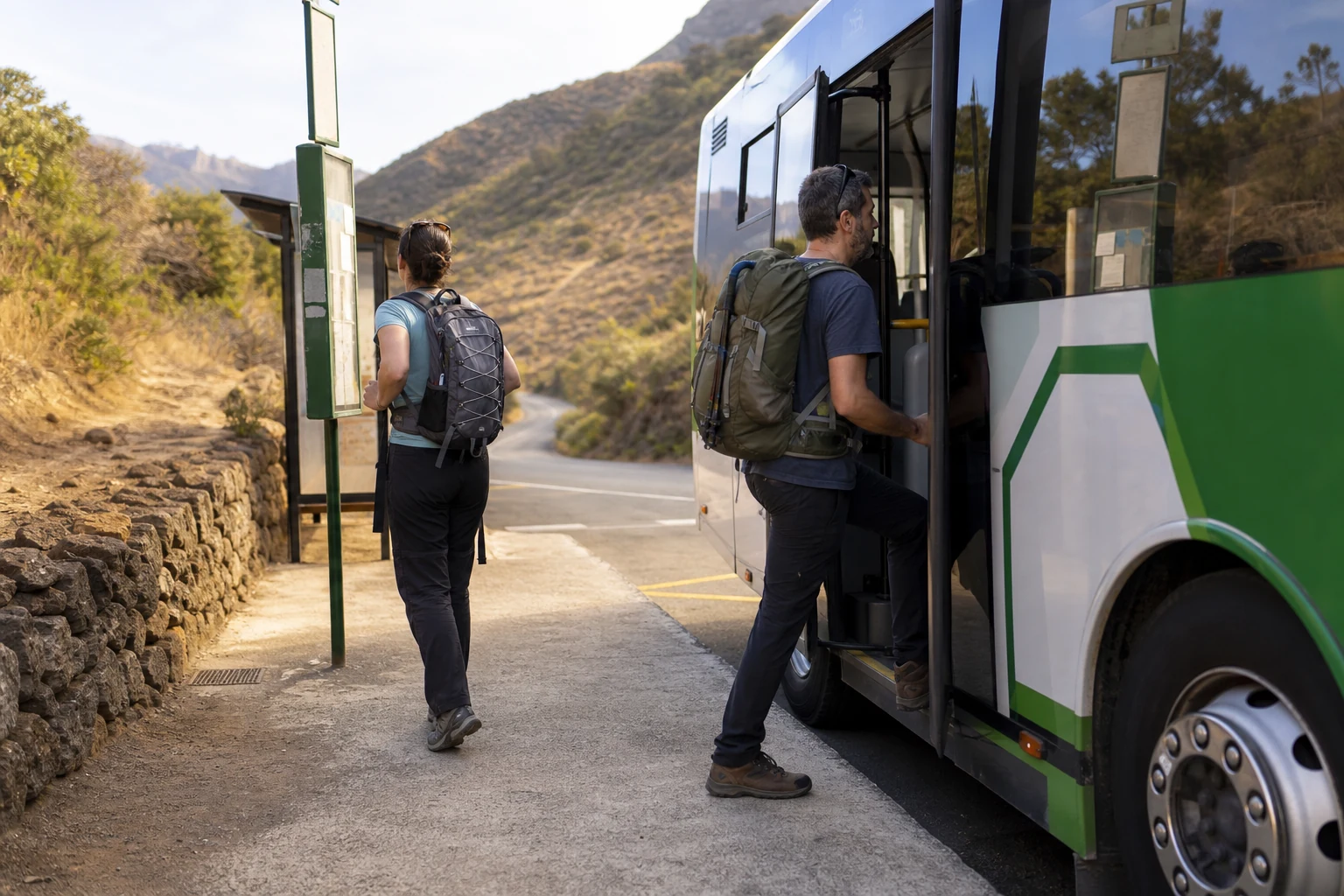
The scene in the photograph is the intended end state: two walkers arrive at the correct roadside stop with daylight remaining, and the bus is part of the plan rather than a lucky rescue. The image belongs here because the article repeatedly depends on that same action?identifying the finish, confirming the stop and boarding within a planned window.
Change the walk when the return is uncertain
A transport problem is a route-selection problem. If the finish has no service, the last departure leaves no margin or the fallback pickup cannot be described precisely, choose a circular walk, shorten the route, use an organised transfer or postpone it. Do not make speed the solution; rushing a descent creates a different risk.
The practical test is simple. You should be able to name the finish, the stop, two possible departures and one fallback without opening five browser tabs. When those answers are clear, a one-way Tenerife walk can feel wonderfully spacious. When they are not, the better travel decision is to redesign the day before the first step.